XYZ Gantry Robot RG-0004 | 3 DOF | 2000x2000x1000mm | 10kg
)
Variants: With cabinet control system
XYZ Gantry Robot for Large-Scale and Precise Automation
The igus® XYZ gantry robot DLE-RG-0004 offers ±0.5 mm accuracy and a spacious working area of 2000 × 2000 × 1000 mm. With a max payload of 10 kg, 1 m/s speed, and up to 20 picks/min, it’s ideal for large-scale and dynamic automation tasks.
Controlled via igus® Robot Control or Dryve D1 – supporting Modbus TCP/IP, CANopen, ROS, digital I/Os, and LabVIEW. The intuitive 3D interface enables easy programming, visualization, and seamless integration into existing systems.
Recommended for pick & place, packaging, lab automation, and assembly. Perfect for industrial production, research labs, and SMEs focused on efficiency, scalability, and low maintenance.
Highlights
Fit to your needs
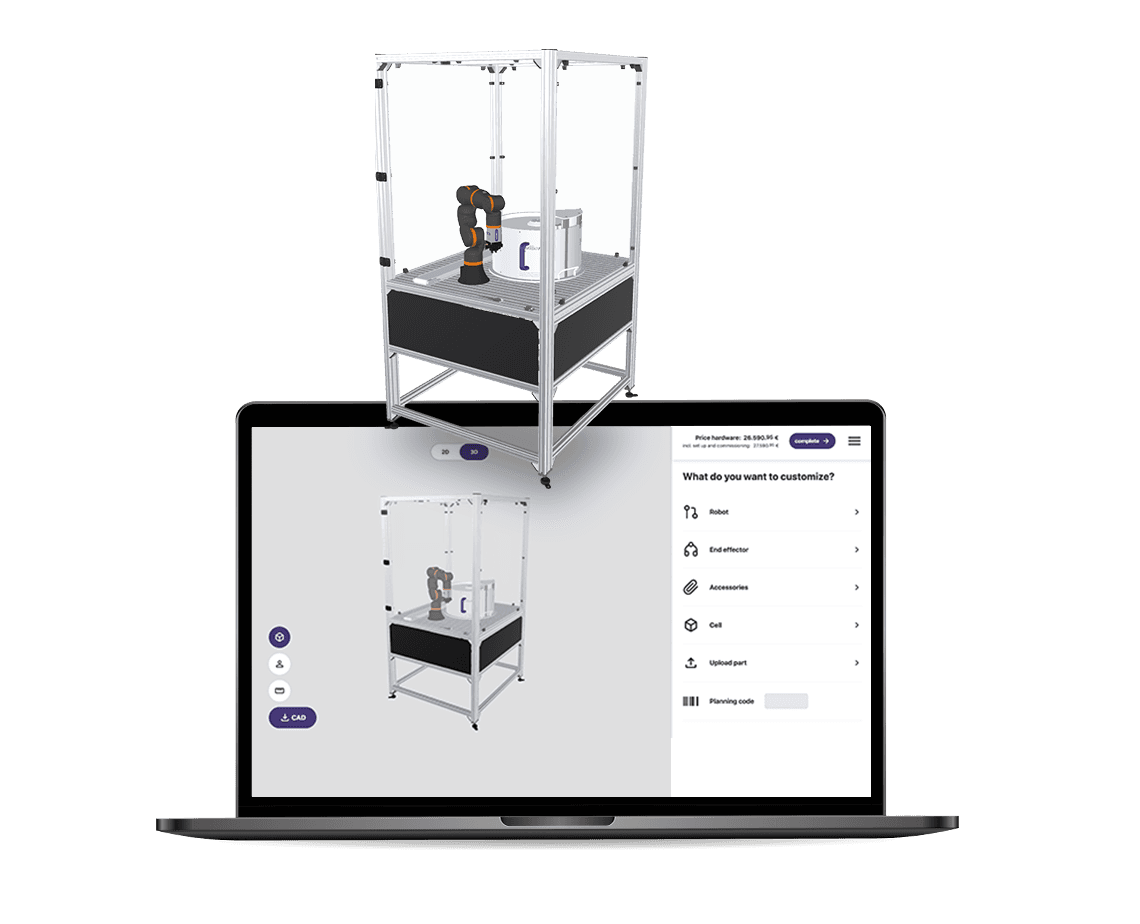
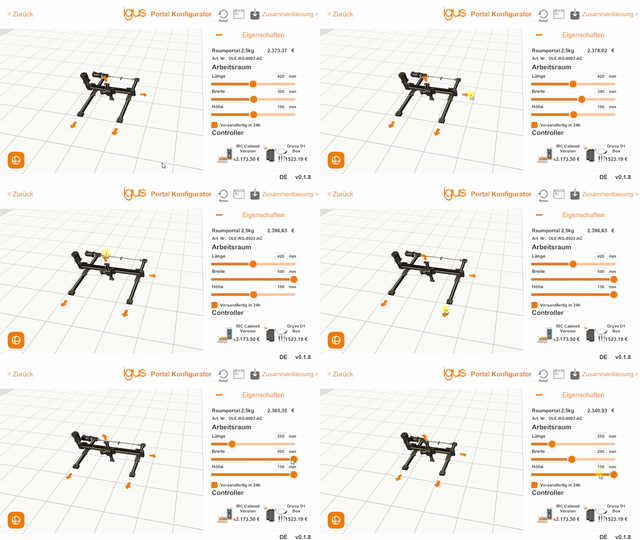
Portal configurator
Customize the linear robot to your needs! Simply enter your desired dimensions. You can then download the CAD file and receive a summary by email.
 "https://a.storyblok.com/f/298593/12b15ce6f5/lca_gen_irc-mockup-pc_de_1-removebg-preview__1_.png")
Free Download
Download now and try it out in advance
Download the software now for free. This allows you to familiarize yourself with the user interface and functions even before you buy the components. With the Digital Twin you get an overview of the possibilities of your robot. (System requirements: Windows 10 PC, free USB 2.0 port, Ethernet port, 500 MB free storage)
 "https://a.storyblok.com/f/298593/1402544cb7/fg0002-portal_irc__2___1_.png")
Typical application areas
Gantry robots are particularly suitable for pick & place applications in various areas. For example, in the laboratory, in manufacturing, for applications with adhesives or in vertical farming. They are compatible with various camera systems, grippers and accessories and can therefore also be used in bin-picking applications.
XYZ Gantry Robots: Frequently Asked Questions
1. What exactly is an XYZ Gantry Robot and how does it work?
An XYZ gantry robot is a robotic system that operates on three linear axes (X, Y, and Z) that are perpendicular to each other, forming an overhead structure. Motors move a tool or end-effector precisely along these rails to position it anywhere within a rectangular 3D workspace. Unlike jointed robots, gantry robots move by sliding along straight lines.
2. What are the primary benefits of using an XYZ Gantry Robot in an industrial application?
XYZ gantry robots offer high precision and repeatability, making them ideal for tasks requiring tight tolerances. Their work envelopes are easily scalable, accommodating very large parts, and their overhead mounting saves valuable floor space. They can also handle heavy payloads and often lead to a lower total cost of ownership due to their robust design and simpler maintenance.
3. What are the main weaknesses or limitations of Gantry Robots?
Gantry robots have limited dexterity, as their movements are strictly linear, making them less suitable for reaching around obstacles or complex, non-linear paths. They require significant overhead clearance and structural support. For very large systems, the mass can limit acceleration, and while they save floor space, their overhead footprint can be substantial.
4. How do Gantry Robots compare to Articulated (6-axis) Robots?
XYZ gantry robots have a rectangular, scalable workspace and offer very high precision, often with higher payload capacities. They save floor space by being mounted overhead and are generally simpler to program. Articulated robots, conversely, have a spherical workspace, offer high dexterity for complex movements, and are better suited for tasks like welding or painting.
5. When should I consider a Gantry over a SCARA or Delta Robot?
Choose a gantry robot when your application requires a large 3D workspace, handles heavier payloads, and needs high precision over a wide area. SCARA robots are best for high-speed, precise 2D planar tasks, while Delta robots excel at extremely high-speed, lightweight pick-and-place operations over a smaller, circular area, especially on conveyor belts.
6. What types of applications are XYZ Gantry Robots best suited for?
XYZ gantry robots are ideal for large-scale material handling, precision dispensing and coating, automated assembly of large components, machining and cutting of large workpieces, detailed inspection and measurement over expansive surfaces, and heavy-duty palletizing or depalletizing.
7. What factors should I consider when specifying an XYZ Gantry Robot for my project?
Key considerations include the exact work envelope size, required payload capacity, necessary speed and acceleration for cycle times, and the precision and repeatability needed. Also, evaluate the environmental conditions, available structural support for mounting, the design of the end-effector, and compatibility with your existing control systems and budget.
8. What kind of maintenance and operational considerations should I be aware of for a Gantry Robot?
Regular maintenance involves lubricating linear bearings and ball screws, and periodically inspecting mechanical components for wear. While highly repeatable, occasional calibration may be needed for absolute accuracy. Ensure control software is updated, operators are properly trained, and maintain a stock of critical spare parts to minimize downtime.
Low cost solutions built with RBTX
Book a free video call with our experts